.png)
Foundation Friday: Case Study: Full Interior Repointing, Lally Column Installation and DryLok Application in Worcester, Ma (FULL VIDEO!)
- Feb 13
- 3 min read

On this Foundation Friday, we’re highlighting a multi-scope foundation repair project completed at a residential property in Worcester MA. This 1880 New England home required full interior repointing, structural reinforcement with lally columns, and DryLok masonry waterproofing to restore long-term stability and moisture resistance.
Older homes in Worcester and throughout Massachusetts frequently present similar challenges due to age, soil conditions, and historic construction methods.
Understanding Historic Stone Foundations in Worcester MA
Homes built in the late 1800s were commonly constructed with fieldstone foundations using lime-based mortar. Unlike modern cement mortar, lime mortar was intentionally softer and more flexible. This allowed minor movement without cracking the surrounding stone.
However, over time, repeated freeze-thaw cycles, groundwater saturation, and natural settlement cause mortar joints to deteriorate.
Once mortar erodes:
• Structural cohesion weakens
• Stones begin to shift
• Gaps form between joints
• Moisture intrusion increases
• Interior humidity levels rise
When this occurs, the foundation begins losing both load-bearing capacity and water resistance.
Full Interior Repointing in Worcester MA
The first phase of this project involved full interior repointing to restore structural integrity.

What Is Repointing?
Repointing is the process of removing deteriorated mortar and replacing it with properly mixed, compatible mortar to restore joint strength and stability.
This project required:
• Removing loose mortar to appropriate depth
• Cleaning and preparing all joints
• Installing new mortar compatible with historic masonry
• Proper joint tooling for durability and moisture resistance
Why Full Repointing Was Necessary
Spot repairs are rarely sufficient in foundations of this age. Full interior repointing was required to:
• Re-establish compressive strength
• Stabilize load-bearing masonry units
• Prevent continued joint erosion
• Reduce water penetration pathways
• Improve long-term structural reliability
Repointing restored the structural continuity of the foundation before any waterproofing system was applied.
Lally Column Installation and Structural Beam Support in Worcester MA
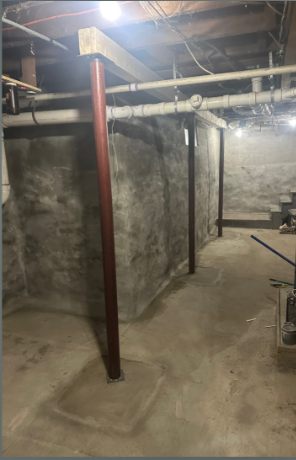
In addition to mortar deterioration, this property showed signs of structural load concerns, including beam deflection and uneven floor distribution.
Why Structural Reinforcement Was Required
Over time, older homes often experience:
• Wood beam sagging
• Shifting load paths
• Settlement beneath existing supports
• Inadequate original footing size
To properly address these concerns, three new lally columns were installed.
Each column was placed on a properly sized reinforced concrete footing. Correct footing sizing is critical because:
• It distributes load evenly
• It prevents settlement
• It transfers weight safely to stable soil
• It avoids future structural shifting
A beam was then installed to evenly distribute loads across the new support columns.
Structural Improvements Achieved
This reinforcement provided:
• Reduced floor deflection
• Improved load path stabilization
• Long-term structural support
• Enhanced foundation system performance
Structural reinforcement must always address the source of load stress rather than simply supporting visible sagging.
DryLok Masonry Waterproofing Application in Worcester MA

After allowing proper curing time for the new mortar (approximately 30 days), DryLok masonry waterproofing was applied.
Why Curing Time Matters
Fresh mortar contains moisture. Applying waterproof coatings too early can trap moisture inside the masonry, leading to adhesion failure or blistering.
Allowing adequate curing ensures:
• Proper mortar strength development
• Reduced trapped moisture risk
• Improved coating adhesion
• Long-term performance
What DryLok Actually Does
DryLok is a masonry waterproof coating designed to reduce moisture vapor transmission through porous surfaces.
It does not repair structural cracks. Instead, it functions as a complementary moisture management layer when applied after structural restoration.
Benefits include:
• Reduced vapor transmission• Brighter basement appearance• Improved air quality conditions• Additional moisture resistance
Waterproof coatings should support sound masonry—not mask failing materials.
Why a System-Based Foundation Repair Approach Was Critical
This Worcester MA foundation repair project required a coordinated system:
• Masonry restoration• Structural reinforcement• Moisture management
Addressing only one issue would not have created a long-term solution.
Repointing alone would not correct load stress.Installing columns alone would not reduce moisture intrusion.Applying waterproofing alone would not stabilize masonry.
The integrated approach ensures the foundation performs as a cohesive system rather than relying on temporary or isolated fixes.
When Should Worcester Homeowners Consider Similar Repairs?
You may need full interior repointing, lally column installation, or masonry waterproofing if you notice:
• Crumbling mortar joints
• Visible stone movement
• Musty basement odors
• Persistent moisture staining
• Sagging floors above the basement
• Uneven interior framing
Early evaluation prevents structural escalation and higher long-term repair costs.
Schedule a Professional Foundation Evaluation in Worcester MA
Historic foundations require experienced assessment. Soil type, water table, age of materials, and structural load all influence the correct repair strategy.
If your home shows signs of mortar deterioration, structural movement, or basement moisture, professional evaluation is the first step.
Call 833-NECRACK (833-632-7225) or contact us online to schedule a free onsite foundation inspection.
The proof is in the pictures and the video!


Comments